About CSDS
CSDS is one of the largest healthcare simulation providers in Australia. We develop and provide evidence-based training and education to support the improvement of patient outcomes across Queensland. At its core, we are an education service with the people, technology, connections, resources, and facilities to empower clinicians with new skills, up-to-date knowledge, and clinical confidence through engaging and practical learning experiences.
About the Digital and Design Team
The Digital and Design Team is one of the many functional teams inside CSDS. The team has a lead, two product designers, and two web developers.
The team supports CSDS’s mission by maintaining and improving custom software that facilitates equipment management and online education for the state-wide Pocket Centre Network. Additionally, the team is responsible for designing and delivering accessible educational content for clinicians, along with producing promotional resources for the educational courses conducted at CSDS.
The team designs and develops digital products and solutions, drawing from their knowledge in product design, software engineering and development, data science, and marketing. They collaborate with CSDS users, subject-matter experts, and researchers to help CSDS achieve and be known for providing world-class, evidence-based clinical and simulation education. In 2021, the team was a finalist in the Metro North Staff Excellence Awards under the High Performance Category.
The team achieves its purpose by:
- Leveraging divergent skills
- Adopting a multidisciplinary approach in designing solutions
- Using an outcome-driven problem-solving approach
More articles about the team
Development stack (tools, software, hardware)
- LAMP, Yii/Yii2 for back-end stack
- KnockoutJS, Angular.js, HTML, JS, and SASS for front-end stack
- Jenkins, AWS for DevOps
- Docker, K3d, Lens for local dev
- WordPress for content management of our website
- JIRA/Confluence for team-based task tracking and knowledgebases
- Office365 for documents and internal communication
- Mandrill for transactional emails
- Queensland Health Design System for public-facing websites
- Eleventy for static site generation
- GitHub for source code version control
- Visual Studio Code for front-end coding
- Macbook Pro 2016 for hardware
Design stack (tools, software, hardware)
- Adobe Creative Suite (i.e., Photoshop, Illustrator, and InDesign) for print
- Figma for prototyping and ideas generation, and quick digital assets
- WordPress for content management of our website
- JIRA/Confluence for team-based task tracking and knowledgebases
- Office365 for documents and internal communication
- Mailchimp for email campaigns and transactional emails
- HTML, JS, and SASS for front-end markup
- Queensland Health Design System for public-facing websites
- Eleventy for static site generation
- GitHub for front-end source code version control
- Visual Studio Code for front-end coding
- Macbook Pro 2016 for hardware (may switch to Windows this year)
Recent projects
Safety and Quality Education Program Online Knowledge Hub
Earlier this year, we collaborated with the Metro North Clinical Governance and the Clinical Leadership Excellence Queensland to develop the Safety and Quality Education Program (SQEP); a direct response to the Metro North Hospital and Health Services’ Caboolture Hospital Independent Governance Review. This project addressed critical patient safety and quality gaps through comprehensive and multimodal educational resources. We launched all these resources on our Safety and Quality Education program website.
SQEP has been widely praised for its comprehensive range of resources. SQEP’s website has attracted 30,000+ page views while our online courses have garnered over 14,000 responses and achieved an average rating of 4.7 out of 5. Our partnership with Clinical Leadership Excellence resulted in 90+ virtual educational sessions that have trained 600+ staff members.
Queensland Spinal Cord Injuries Online Knowledge Hub
We collaborated with the Queensland Spinal Cord Injuries Service to produce an online knowledge hub for healthcare professionals and patients dealing with spinal cord injuries across Queensland and Northern NSW. This project addressed the lack of proficiency among many healthcare professionals in managing spinal cord injuries due to the condition’s rarity, bridged the gap in specialist care access, and empowered non-spinal cord injury specialist healthcare providers in remote and regional areas.
The Queensland Spinal Cord Injuries Service Online Knowledge Hub project was a finalist in the 2023 Metro North Staff Excellence Awards under the People Focus Award.
Maternity Education Program (MEP)
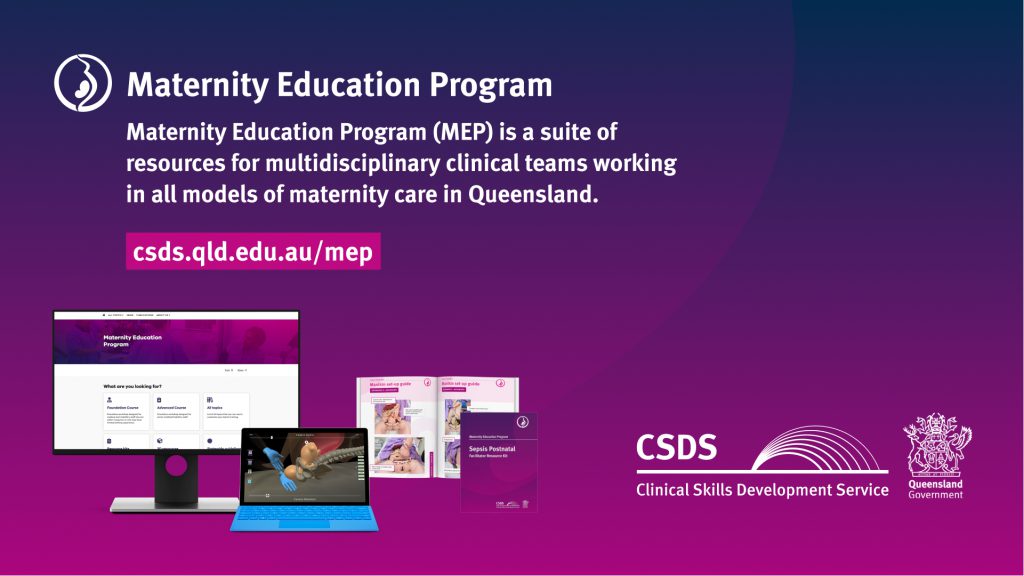
MEP is an award-winning state-wide training and education program for healthcare professionals working in a maternity care environment. MEP was a multidisciplinary collaboration between subject-matter experts, the CSDS Research team, a statewide group of midwives, and our team.
Our team provided the strategy, design, and development of the digital components of the program. These components included a publicly accessible website as its distribution model, resource kits for facilitators and participants, two 3D animations as novel training tools, and MEPcast- a podcast for midwifery educators in Queensland.
The Maternity Education Program project won the 2021 Bond University Sustainable Healthcare Award on Education and Health Literacy, 2021 Metro North Staff Excellence Award in Innovation for “The development of a 3D interactive animation to improve the teaching of shoulder dystocia obstetric emergency” and was a finalist in the 2021 Metro North Health Safety and Quality Awards.
Queensland Trauma Education (QTE)
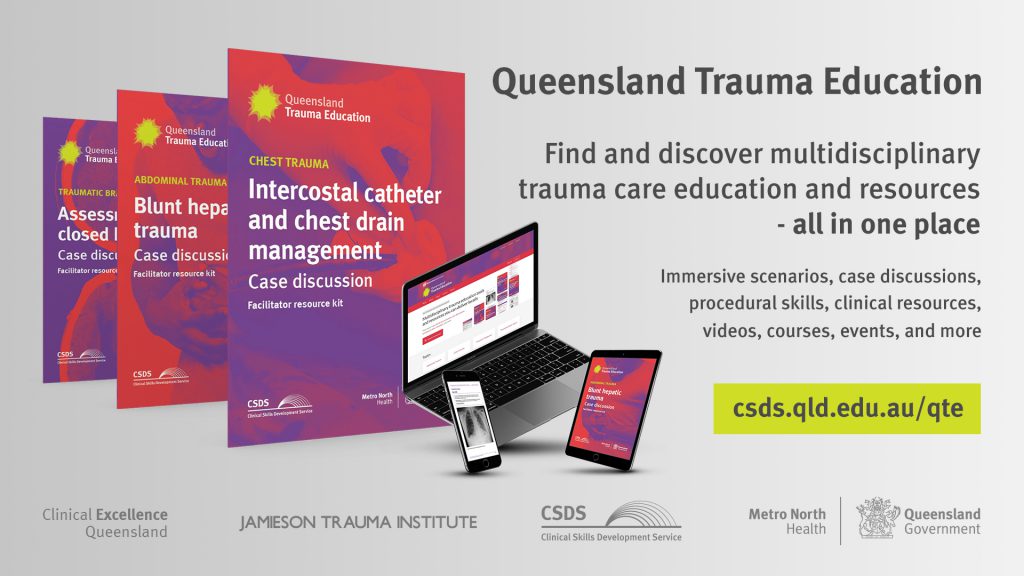
Traumatic events are a common cause of hospital presentations in Australia, with 12,000 annual deaths attributable to injuries sustained. Patients requiring hospital care often present after a fall (40%) or transport-related trauma (13%). QTE was developed in collaboration with Queensland Health trauma specialists and state-wide clinical networks to create and provide structured, relevant, and best practice care education to clinicians who care for the injured. QTE was launched earlier this year and can be accessed at https://archive.csds.qld.edu.au/qte.
Our team provided the design and development to deliver QTE successfully. The support came in the following forms: design of visual identity, development of a website and distribution platform to publish and share resources, design and development of training resource kits for facilitators and participants, and the design and copywriting marketing collateral.
Genetic Kidney Disease Decision Aid
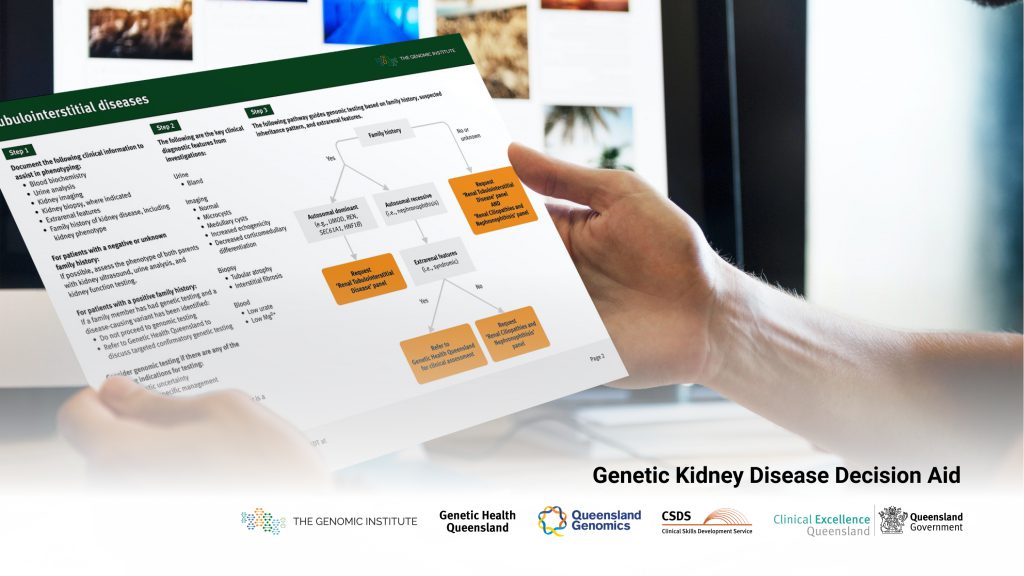
The GKD Decision Aid was developed in collaboration with the Genomics Institute, Genetic Health Queensland, and the CSDS Research Team. This project supports mainstreaming genetic testing in renal medicine as a diagnostic tool. Our team provided the design expertise necessary for the success of the project. Some of the techniques used were perceptual grouping, linear design, and pattern matching.
The GKD Decision Aid project won the 2021 Metro North Health Staff Excellence Award in Training and Education and was presented at Australasia’s 44th Annual Scientific Meeting of the Human Genetics Society and the Herston Health Symposium 2021.
Creatinine Clearance Calculator
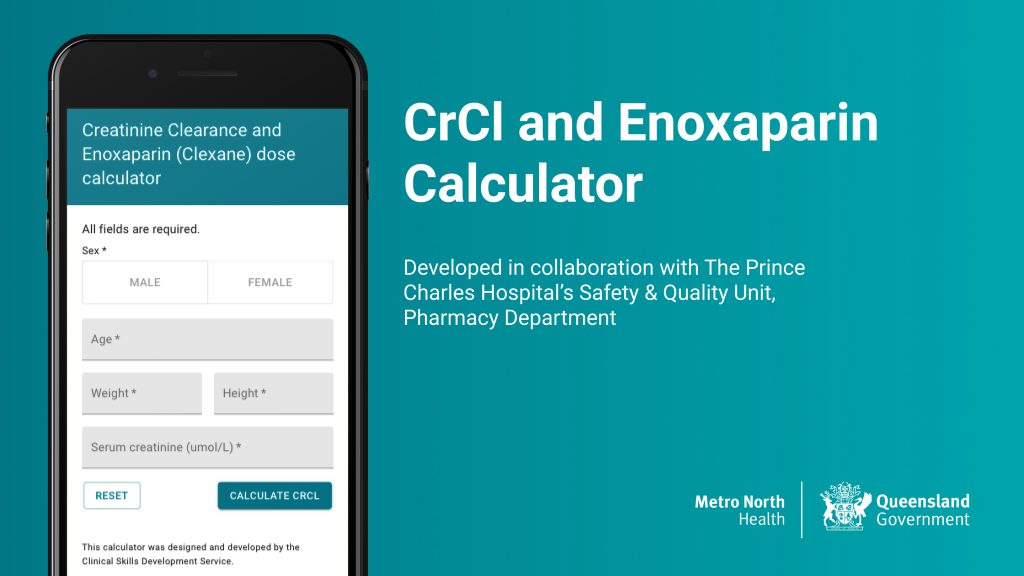
In collaboration with The Prince Charles Hospital, the calculator was developed in response to the recommendations of a formal Human Error and Patient Safety review conducted after critical incidents involving enoxaparin guidelines. The current calculator is an Excel file accessed on desktop computers within the hospital’s clinical areas.
Our team designed and developed a web-based app that addressed the HEAP review’s recommendations and improved clinicians’ user experience using the calculator.